Climate Chart of La Paz, Bolivia
Monthly data: Temperature °C, Rain (mm), Sunshine (h) · 2013–2023
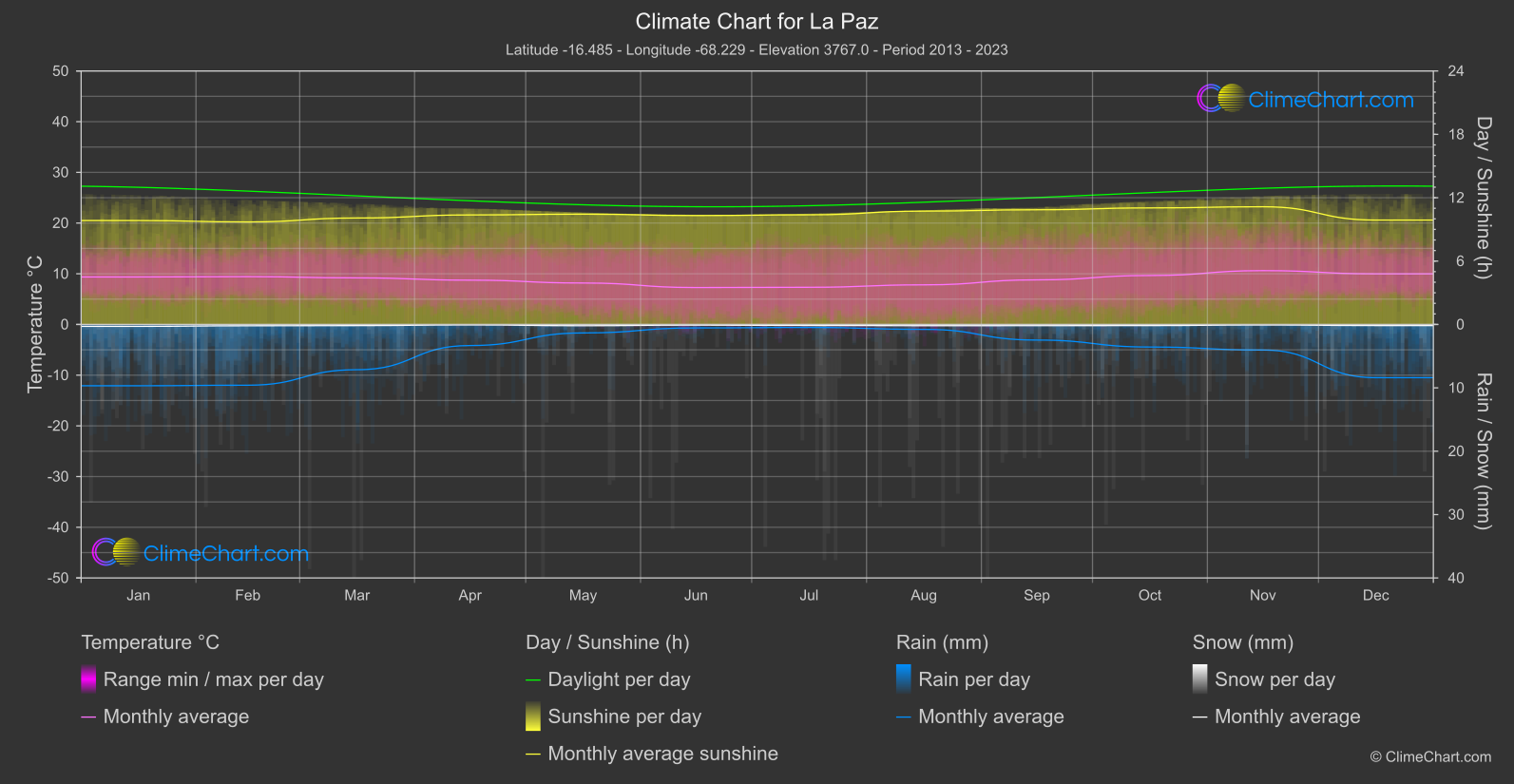
For La Paz, Bolivia, the climate data cover 2013–2023 and describe a year with cool monthly mean temperatures, measurable daily rainfall and snowfall averages, and substantial sunshine. The monthly mean temperature averages 8.9 °C across the calendar months, while mean daily sunshine averages 10.40 hours/day. These summaries provide a broad orientation rather than a forecast: monthly temperature means are not daytime highs, and daily precipitation averages do not indicate how often precipitation falls.
Climate overview
Temperature
Monthly mean temperatures reach their highest point in November, at 10.6 °C. This describes the average for the month, not the daytime maximum, so it is best used as a broad guide to the month's typical temperature rather than a prediction for any particular afternoon. The coolest monthly means are shared by June / July, at 7.3 °C. The tie means these months have the same reported minimum; visitors prioritising cooler monthly averages may use them as a reference, while allowing for day-to-day conditions to vary.
Rain
Mean daily rainfall is highest in January, at 4.84 mm/day. This average supports preparing for possible wet weather, but it does not tell you how many rainy days to expect or guarantee rain on a particular day. The lowest mean daily rainfall occurs in July, at 0.24 mm/day. It may suit visitors who prioritise lower average rainfall, though the figure is a daily mean rather than a promise of dry weather. Across the calendar months, the unweighted mean is 2.14 mm/day per day.
Sunshine
Mean daily sunshine reaches 11.14 hours/day in November, the highest monthly mean in the record. That can help with planning daylight outdoor activities, but sunshine duration is not the same as day length and does not guarantee uninterrupted sun. The lowest mean daily sunshine is 9.71 hours/day in February; the unweighted mean across the calendar months is 10.40 hours/day. These averages offer a planning guide, not a measure of conditions on each day.
Snow
Mean daily snowfall is highest in January, at 1.50 mm/day. This records an average amount, not the number of snowy days, snow depth or snow cover, so it cannot establish whether snow will affect a visit. The lowest monthly mean is 0.37 mm/day in April; the unweighted mean across calendar months is 0.86 mm/day per day.
Best Travel Time Guide for La Paz, Bolivia: Ideal Seasons and Weather Insights
For travel weather, July is a conditional option if your priority is lower average rainfall: its mean daily amount is 0.24 mm/day. This does not guarantee dry days or show how frequently rain falls, so consider rain-ready clothing regardless of the monthly average. If cooler monthly mean temperatures are your preference, June / July records the tied low of 7.3 °C; use this as a guide to monthly averages, not a forecast of daytime temperatures. For visitors planning outdoor sightseeing around sunshine, the highest mean daily duration is in November, at 11.14 hours/day, but sunshine duration is not day length.
Prepare for the possibility of wet weather in January, when mean daily rainfall reaches 4.84 mm/day; the average cannot tell you whether rain will fall on a specific day. Recorded mean daily snowfall also peaks in January, at 1.50 mm/day, but that figure does not establish snowy-day frequency, snow cover or travel conditions.
Climate Data Overview for La Paz, Bolivia
Explore the comprehensive climate data for La Paz, Bolivia. This detailed table provides valuable insights into temperature variations, precipitation levels, and seasonal changes, helping you understand the unique weather patterns of this region.
| Month | Average: Temperature °C | Rain (mm) / day | Snow (mm) / day | Sunshine (h) / day |
|---|---|---|---|---|
| Jan | 9.4 | 4.84 | 1.50 | 9.84 |
| Feb | 9.4 | 4.79 | 1.05 | 9.71 |
| Mar | 9.2 | 3.57 | 0.91 | 10.08 |
| Apr | 8.7 | 1.66 | 0.37 | 10.37 |
| May | 8.2 | 0.67 | 1.01 | 10.44 |
| Jun | 7.3 | 0.27 | 0.53 | 10.31 |
| Jul | 7.3 | 0.24 | 0.82 | 10.38 |
| Aug | 7.8 | 0.39 | 0.98 | 10.73 |
| Sep | 8.8 | 1.23 | 0.95 | 10.86 |
| Oct | 9.7 | 1.78 | 0.89 | 11.03 |
| Nov | 10.6 | 2.02 | 0.42 | 11.14 |
| Dec | 10.0 | 4.20 | 0.87 | 9.88 |
| Average | 8.9 | 2.14 | 0.86 | 10.40 |