Climate Change Chart of Marshall Islands, USA
Comprehensive Climate Change Chart of Marshall Islands, USA: Monthly Averages and Impact Trends
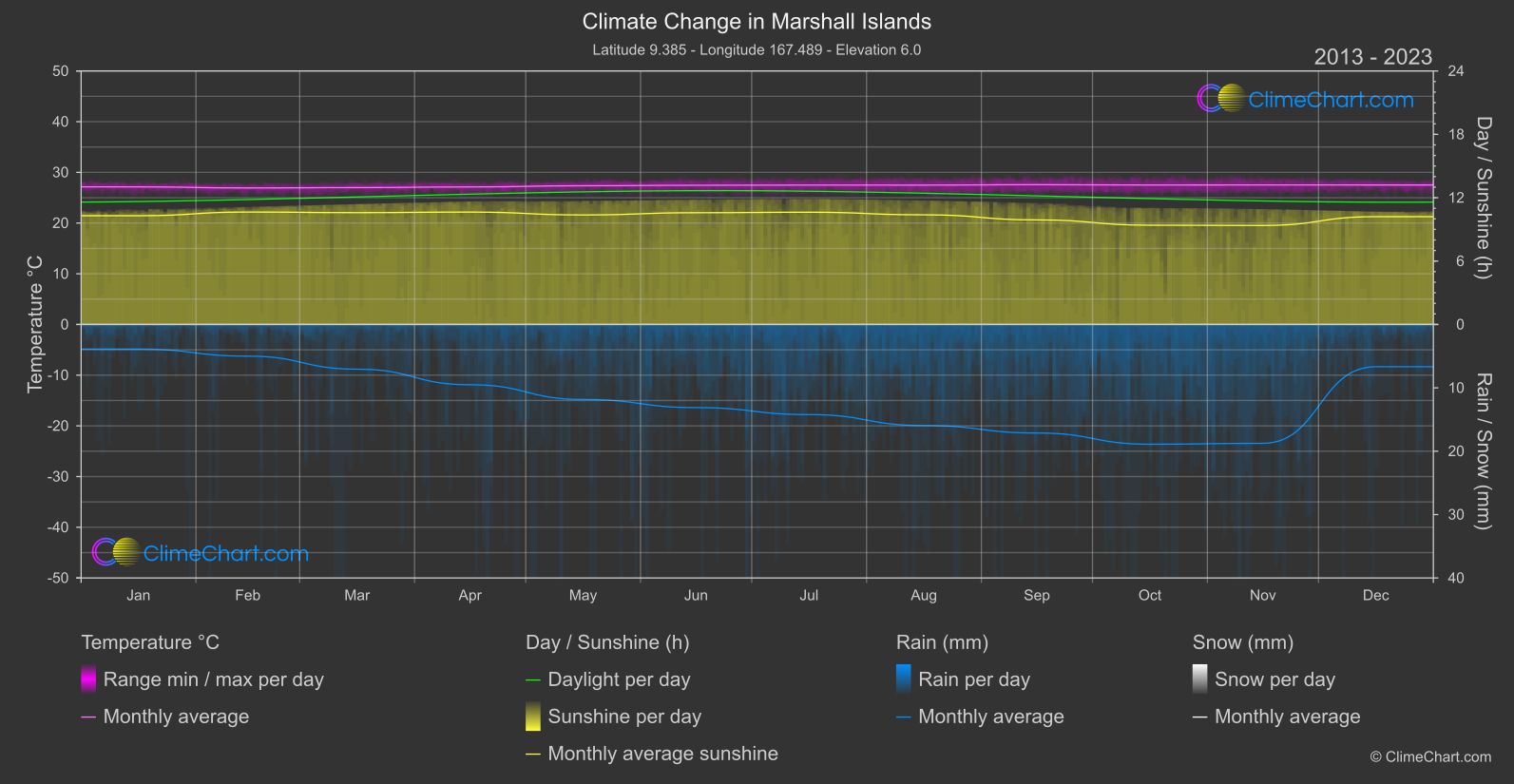
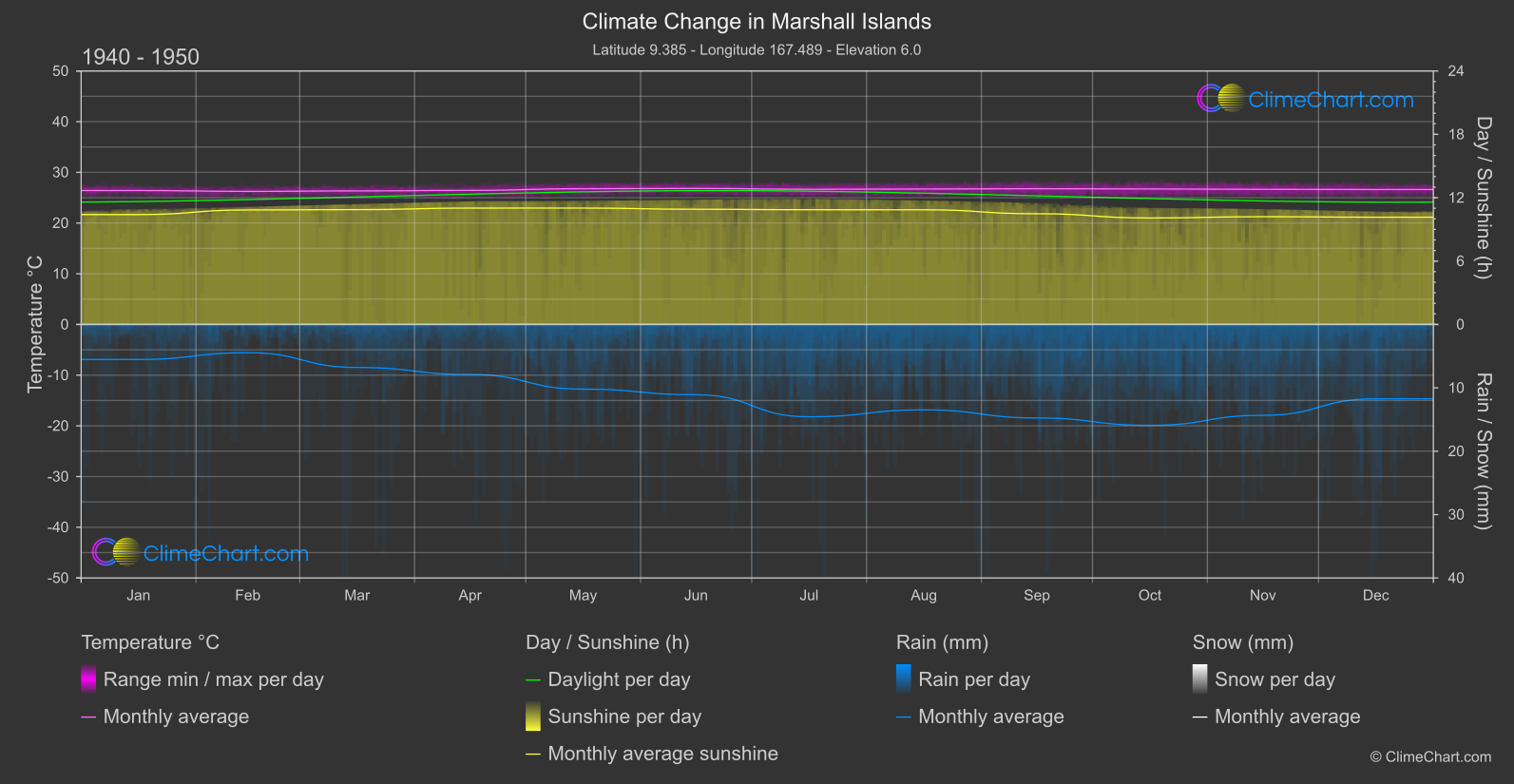
For Marshall Islands, USA, the climate data compare 1940–1950 with 2013–2023.
Monthly mean temperature was higher by a mean difference of +0.74 °C averaged across calendar months; this is an unweighted comparison of monthly means, not a day-weighted annual average or a measure of daytime maximum temperatures. The largest monthly increase was in December, with a difference of +0.90 °C.
Overview of climate changes
Temperature changes
Monthly mean temperature was higher by a mean difference of +0.74 °C averaged across calendar months; this is an unweighted comparison of monthly means, not a day-weighted annual average or a measure of daytime maximum temperatures. The largest monthly increase was in December, with a difference of +0.90 °C. This identifies the strongest increase among the monthly means, rather than describing every month or a continuous change between the reference periods.
Changes in rainfall
Mean daily rainfall had an average difference of +0.47 mm/day across calendar months, averaged across the monthly means; this unweighted mean does not represent a day-weighted annual average, and the figures are daily means rather than monthly totals. The monthly differences were not uniform: November had the largest increase, a difference of +2.21 mm/day, while December had the largest decrease, a difference of -2.53 mm/day. These extremes describe changes in mean daily rainfall for those months, not the direction of change in every month.
Changes in sunshine duration
Mean daily sunshine duration had an average difference of -0.39 hours/day across calendar months. This is an unweighted mean of monthly means, not a day-weighted annual average, and it does not imply the same change in each month. The largest monthly decrease was in November, with a difference of -0.83 hours/day. By contrast, the largest increase occurred in December, at a difference of +0.05 hours/day, showing that monthly sunshine differences varied in direction.
Climate Change Data Overview for Marshall Islands, USA
Explore the comprehensive climate change data for Marshall Islands, USA. This detailed table provides valuable insights into temperature variations, precipitation levels, and seasonal changes influenced by climate change, helping you understand the unique weather patterns of this region.
Temperature °C
| Month | ⌀ 1940 - 1950 | ⌀ 2013 - 2023 | +/- |
|---|---|---|---|
| Jan | 26.42 | 27.14 | 0.72 |
| Feb | 26.25 | 26.92 | 0.68 |
| Mar | 26.34 | 27.00 | 0.66 |
| Apr | 26.45 | 27.12 | 0.68 |
| May | 26.78 | 27.36 | 0.58 |
| Jun | 26.84 | 27.45 | 0.62 |
| Jul | 26.66 | 27.49 | 0.83 |
| Aug | 26.71 | 27.49 | 0.77 |
| Sep | 26.78 | 27.57 | 0.80 |
| Oct | 26.73 | 27.50 | 0.78 |
| Nov | 26.66 | 27.52 | 0.86 |
| Dec | 26.62 | 27.51 | 0.90 |
| ⌀ Month | 26.60 | 27.34 | 0.74 |
Sunshine (h) / day
| Month | ⌀ 1940 - 1950 | ⌀ 2013 - 2023 | +/- |
|---|---|---|---|
| Jan | 10.40 | 10.30 | -0.11 |
| Feb | 10.84 | 10.64 | -0.20 |
| Mar | 10.87 | 10.59 | -0.29 |
| Apr | 11.02 | 10.64 | -0.38 |
| May | 11.02 | 10.37 | -0.65 |
| Jun | 10.91 | 10.58 | -0.33 |
| Jul | 10.86 | 10.63 | -0.24 |
| Aug | 10.86 | 10.38 | -0.47 |
| Sep | 10.48 | 9.90 | -0.58 |
| Oct | 10.08 | 9.40 | -0.68 |
| Nov | 10.20 | 9.37 | -0.83 |
| Dec | 10.15 | 10.21 | 0.05 |
| ⌀ Month | 10.64 | 10.25 | -0.39 |
Rain (mm) / day
| Month | ⌀ 1940 - 1950 | ⌀ 2013 - 2023 | +/- |
|---|---|---|---|
| Jan | 2.76 | 1.94 | -0.82 |
| Feb | 2.23 | 2.50 | 0.27 |
| Mar | 3.39 | 3.53 | 0.14 |
| Apr | 3.95 | 4.76 | 0.81 |
| May | 5.10 | 5.92 | 0.81 |
| Jun | 5.55 | 6.56 | 1.01 |
| Jul | 7.29 | 7.11 | -0.18 |
| Aug | 6.74 | 7.98 | 1.24 |
| Sep | 7.38 | 8.56 | 1.19 |
| Oct | 7.96 | 9.45 | 1.49 |
| Nov | 7.17 | 9.38 | 2.21 |
| Dec | 5.86 | 3.33 | -2.53 |
| ⌀ Month | 5.45 | 5.92 | 0.47 |
Snow (mm) / day
| Month | ⌀ 1940 - 1950 | ⌀ 2013 - 2023 | +/- |
|---|---|---|---|
| Jan | 0.00 | 0.00 | 0.00 |
| Feb | 0.00 | 0.00 | 0.00 |
| Mar | 0.00 | 0.00 | 0.00 |
| Apr | 0.00 | 0.00 | 0.00 |
| May | 0.00 | 0.00 | 0.00 |
| Jun | 0.00 | 0.00 | 0.00 |
| Jul | 0.00 | 0.00 | 0.00 |
| Aug | 0.00 | 0.00 | 0.00 |
| Sep | 0.00 | 0.00 | 0.00 |
| Oct | 0.00 | 0.00 | 0.00 |
| Nov | 0.00 | 0.00 | 0.00 |
| Dec | 0.00 | 0.00 | 0.00 |
| ⌀ Month | 0.00 | 0.00 | 0.00 |